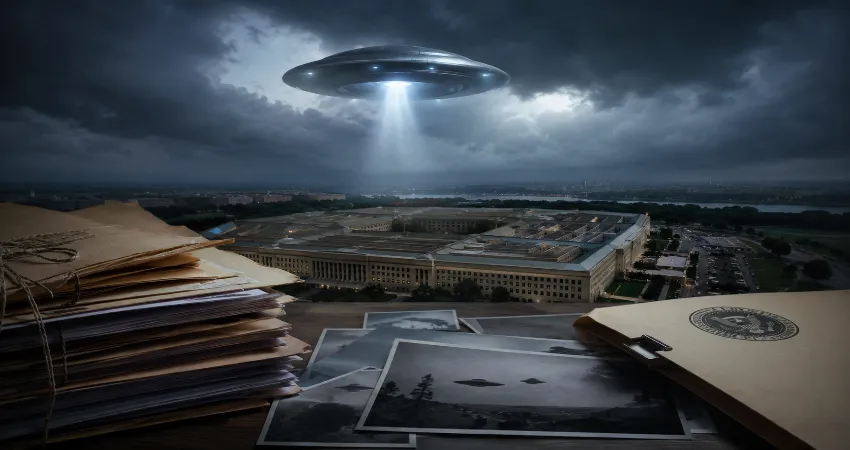
For generations, the question has lingered in the background of American public life — are we alone? On Friday, the Pentagon took what it described as a historic step toward transparency, releasing a first batch of declassified files related to unidentified anomalous phenomena, the government’s preferred term for what most people still call UFOs.
The files, posted on a dedicated new government website at war.gov/UFO, include 162 documents drawn from the FBI, the Department of Defense, NASA, and the State Department. They span decades — some cases dating to the 1940s, others as recent as last year. The release was ordered by President Donald Trump, who had been building anticipation for weeks with a series of public remarks hinting that the documents would contain genuinely surprising material.
What the files actually contain is more complicated than either believers or skeptics might have hoped.
From Apollo 11 to Cold War Sightings
Among the more striking inclusions are documents tied to NASA’s Apollo missions. A 1969 debriefing from the Apollo 11 flight records astronaut Buzz Aldrin describing seeing “little flashes inside the cabin, spaced a couple of minutes apart,” while trying to sleep during the mission. A photograph from the Apollo 17 mission in December 1972 shows what is described as “three dots in a triangular formation” in the lunar sky.
The Pentagon noted that while the image had been previously released, a new review of the original film is underway. “There is no consensus about the nature of the anomaly,” the Pentagon caption read. “New preliminary US government analysis suggests the image feature is potentially the result of a physical object in the scene.”
Another Apollo 17 document records astronaut Jack Schmitt reporting a flash on the lunar surface near the Grimaldi crater.
The FBI’s contribution to the release spans 18 documents covering reported sightings of unidentified objects and “flying discs” from 1947 to 1968. One particularly vivid entry is a composite sketch — an FBI photograph overlaid with a graphic drawn from an eyewitness account — depicting what was described as an “apparent ellipsoid bronze metallic object materialising out of a bright light in the sky, 130 to 195 feet in length, and disappearing instantaneously.”
There is also a Cold War-era case from 1955. A group that included then-Senator Richard Russell, who chaired the Senate Armed Services Committee, reported seeing two unusual objects from a train window while travelling through the former Soviet Union. The US Air Attaché who prepared the report described the witnesses as “excellent sources.”
🔥 Don’t Miss These News


More Than 400 Incidents, No Confirmed Extraterrestrial Life
The collection covers more than 400 incidents from around the world. Many of the declassified videos consist of grainy infrared footage captured by US military sensors. Among them is a minute and 39 seconds of video from a US Indo-Pacific Command platform, recorded in 2024. The images, for the most part, show indistinct points of light or unusually shaped objects — striking enough to raise questions, but not definitive enough to answer them.
That tension — between what the files hint at and what they actually prove — runs through the entire release. The Pentagon’s own 2024 report stated plainly that no government investigation into UAPs has confirmed the existence of extraterrestrial life. Trump himself, when asked about aliens, has said he is not sure either way.
Expectations, Managed and Otherwise
Trump began laying the groundwork for this release in February, directing federal agencies to declassify their records on UFOs and extraterrestrial-related subjects. At a White House event honouring NASA astronauts, he said: “We’re going to be releasing a lot of things that we haven’t.”
Not everyone was impressed by the build-up. Sean Kirkpatrick, a physicist and former career intelligence officer who led the Pentagon’s All-domain Anomaly Resolution Office until 2023, pushed back against the framing. He said Trump’s promises amounted to a “shiny object” designed to distract the public, and that having reviewed the government’s actual records, he did not believe any bombshell revelations were buried in them.
Others took a more measured view. As one analyst put it, for the most committed UFO researchers, disappointment is almost guaranteed regardless of what surfaces. The gap between what enthusiasts hope to find and what declassified documents typically deliver is rarely bridged by a single release.
What Comes Next
The Pentagon said further files will be added to the war.gov/UFO website on a rolling basis. Congress created the All-domain Anomaly Resolution Office in 2022 specifically to investigate UAP reports and declassify as much material as responsibly possible. A second report from the office, covering more recent sightings, is expected soon.
Whether the files that follow will go further than this first batch — or whether the most consequential questions will remain, as they have for decades, unanswered — is something that only time, and continued pressure for transparency, will tell.