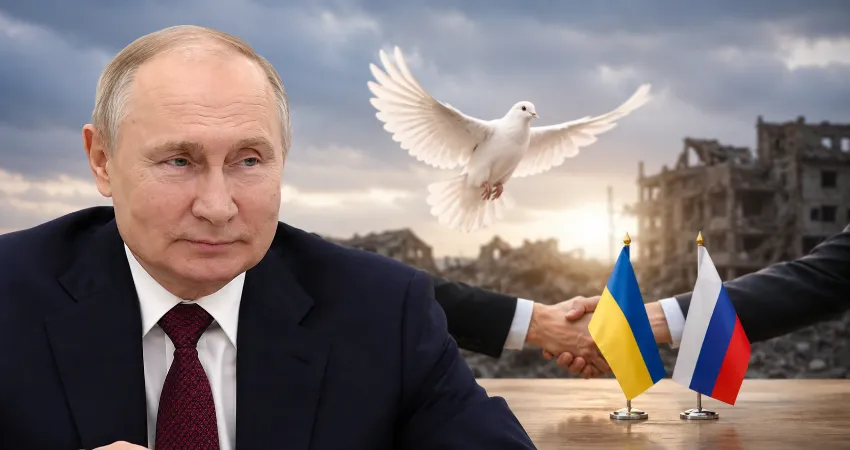
Vladimir Putin stood before reporters on Saturday with the kind of measured confidence that has defined his public persona for more than two decades. The occasion was Victory Day — Russia’s most solemn annual commemoration — but the words that drew the most attention had nothing to do with World War II. The Russian president suggested that his country’s war on Ukraine may be nearing its conclusion.
“I think the matter is coming to an end,” Putin said, in remarks that were brief but significant given how rarely Moscow has signalled any openness to ending a conflict it has prosecuted with grinding determination for more than four years.
The comments came hours after Putin addressed troops at a notably scaled-back Victory Day parade in Moscow’s Red Square. This year, tanks and missile systems did not roll through the square as in previous years. Instead, videos of military hardware played on giant screens. The change in format was a reflection, analysts noted, of both the logistical demands of the ongoing war and the diplomatic atmosphere surrounding the ceasefire announcement.
A Parade With a New Face
The parade itself carried its own symbolism. For the first time, North Korean troops marched alongside Russian forces — a visible acknowledgement of Pyongyang’s military contribution to Moscow’s war effort. North Korea had sent soldiers to help repel a Ukrainian incursion into Russia’s Kursk region, and Saturday’s ceremony was a formal, public tribute to that partnership.
Putin used his address to frame the war in the language he has consistently employed: a defensive struggle against an expansionist West. He praised Russian troops for fighting a “just cause” against “an aggressive force armed and supported by the entire NATO bloc,” and declared — to applause from assembled soldiers — “Victory has always been and will be ours.”
After the parade, speaking to reporters, he returned to familiar grievances. Western “globalist elites,” he argued, had broken post-Cold War promises that NATO would not expand eastward following the fall of the Berlin Wall in 1989. Instead, he said, they had moved to draw Ukraine into the European Union’s orbit — a provocation, in Moscow’s telling, that made conflict inevitable.
Ceasefire and Prisoners
The backdrop to Saturday’s events was an agreement that had taken shape just a day earlier. US President Donald Trump announced on Friday that both Russia and Ukraine had agreed to a three-day ceasefire, running from Saturday through Monday, and would exchange 1,000 prisoners each.
“This Ceasefire will include a suspension of all kinetic activity, and also a prison swap of 1,000 prisoners from each Country,” Trump wrote on Truth Social. He added that talks on ending the war were continuing and that he believed the sides were “getting closer and closer every day.” Striking a cautiously optimistic note, he said: “Hopefully, it is the beginning of the end of a very long, deadly, and hard fought War.”
🔥 Don’t Miss These News
Earlier ceasefires had not held. Russia declared a unilateral halt to fighting for the Victory Day holiday, while Ukraine’s President Volodymyr Zelenskyy announced a truce beginning May 6. Both sides accused the other of violating the terms. This latest ceasefire, brokered through American pressure, carried more weight — though scepticism about compliance remained high on both sides.
Zelenskyy responded to the moment with characteristic defiance. He issued a decree sarcastically “permitting” Russia to hold its Victory Day celebrations and declared Red Square temporarily off-limits for Ukrainian strikes. The Kremlin dismissed the gesture as a “silly joke.”
The Question of a Meeting
Perhaps the most closely watched statement from Putin on Saturday concerned the possibility of a direct meeting with Zelenskyy. The Ukrainian president had previously offered to negotiate face to face, but ruled out travelling to Moscow. Putin had not previously indicated any willingness to meet on neutral ground.
On Saturday, he moved — carefully, and with conditions attached. “A meeting in a third country is also possible,” he said, “but only after a peace treaty aimed at a long-term historic perspective is finalised. This should be a final deal, not the negotiations.”
The framing matters. Putin is not offering to negotiate in person. He is offering to sign a finished agreement, in a third country, once the details have been worked out elsewhere. It is a significant shift in posture, but a narrow one.
On the question of who might facilitate engagement with Europe, Putin expressed a preference for former German Chancellor Gerhard Schröder — a longtime acquaintance and one of the few senior Western figures with whom Moscow still maintains functional relations.
Where Things Stand
Russia controls just under one-fifth of Ukrainian territory. After more than four years of fighting — longer than the Soviet Union fought in World War II — Russian forces have failed to capture the entirety of the Donbas region. Advances have slowed considerably in recent months.
The human cost has been enormous. Hundreds of thousands are dead. Swaths of Ukraine lie in ruins. Russia’s $3 trillion economy has been strained by sanctions, military expenditure, and the loss of Western markets.
Whether Putin’s words on Saturday represent a genuine signal toward peace, or a tactical reframing designed to shape international opinion while the fighting continues, remains the question that nobody outside the Kremlin can answer with confidence.